
Events
An ode to geometry
Workshop in Lisbon, 16-21 September 2024
An ode to Geometry
September 16-21, 2024
Instituto Superior Técnico, Lisbon, Portugal
The workshop “An ode to Geometry,” organized within the framework of the GENIDE project, will bring together leading experts from around the world to explore various facets within the broad field of the geometry of differential equations. The event will feature a series of talks interspersed with ample time for in-depth discussions among participants. Topics covered will range from symplectic geometry and D-module theory to asymptotic analysis and stochastic approaches.
The central theme that ties the sessions together is the richness of the geometric structures underlying ordinary differential equations (ODEs). We aim to create a dynamic environment where fruitful exchanges and collaborations can flourish, advancing our understanding of this fascinating area of mathematics.
Funding projects:
- GENIDE (Ref. 2022.03702.PTDC, DOI: https://doi10.54499/2022.03702.ptdc)
- GFM (Ref. UIDB/00208/2020, DOI: https://doi.org/10.54499/UIDB/00208/2020, Ref. UIDP/00208/2020, DOI: https://doi.org/10.54499/UIDP/00208/2020)
Location: The workshop will take place at the Department of Mathematics, Instituto Superior Técnico (IST), Lisbon, Portugal.
Address: Av. Rovisco Pais 1, 1049-001 Lisboa, Portugal.
Room: P3.10 (3rd floor)
List of Invited Speakers:
- Sílvia Anjos (IST, Lisboa, PT)
- José Julián Barragán Amado (University of Lisbon, Lisboa, PT)
- Bruno Carneiro da Cunha (UFPE, Recife, Pernambuco, Brasil)
- Ana Bela Cruzeiro (IST, Lisboa, PT)
- Gabriele Degano (University of Lisbon, Lisboa, PT)
- Jean Douçot (University of Lisbon, Lisboa, PT)
- Pavel Gavrilenko (SISSA, Trieste, IT)
- Davide Guzzetti (SISSA, Trieste, IT)
- Claus Hertling (University of Mannheim, Mannheim, DE)
- Andreas Hohl (KU Leuven, Leuven, BE)
- Hiroshi Iritani (Kyoto University, Kyoto, JP)
- Martin Klimes (University of Zagreb, Zagreb, HR)
- Oleg Lisovyi (université de Tours, Tours, FR)
- Gonçalo Oliveira (IST, Lisboa, PT)
- Andrea Raimondo (Università di Bergamo, Bergamo, IT)
- Giulio Ruzza (University of Lisbon, Lisboa, PT)
- Rosa Sena Dias (IST, Lisboa, PT)
- Claude Sabbah (Ecole Polytechnique, Palaiseau, FR)
- Jacopo Stoppa (SISSA, Trieste, IT)
- Dmytro Volin (Uppsala University, Uppsala, SE)
- Xiaomeng Xu (School of Mathematical Sciences, Beijing, CN)
Schedule
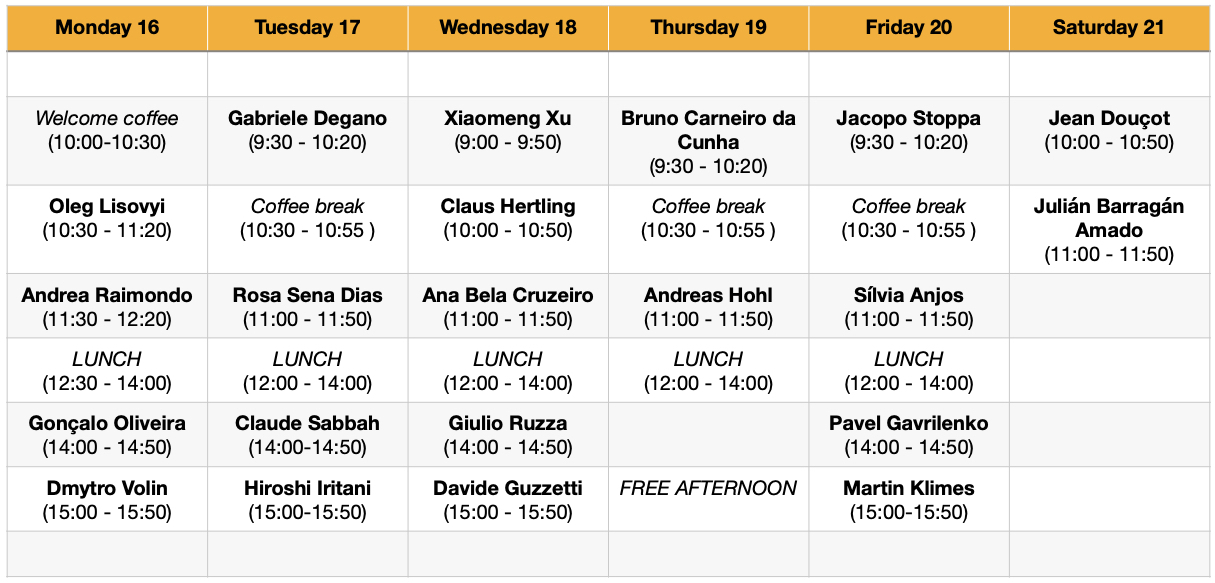
Titles and abstracts
ABSTRACTS (PDF FILE)
Speaker: Sílvia Anjos (IST, Lisboa, PT)
Title: The space of symplectic balls in rational 4-manifolds
Abstract: Existence of symplectic embeddings of k disjoint balls of given capacity c1, . . . , ck into a given symplectic manifold (M, ω) is a central problem in symplectic topology. However, besides a few examples, very little is known about the space of all such embeddings. In this talk, I will discuss the case of rational 4-manifolds with small Euler numbers, with a special attention to the case of the projective plane. In this case, our work reveals an interesting connection with the complex geometry of the configuration space of k distinct points in CP2. This is based on joint works with Jarek Kedra, Tian-Jun Li, Jun Li and Martin Pinsonnault.
Speaker: José Julián Barragán Amado (University of Lisbon, Lisboa, PT)
Title: TBA
Abstract: TBA
Speaker: Bruno Carneiro da Cunha (UFPE, Recife, Pernambuco, Brasil)
Title: Isomonodromy and the accessory parameter problem for conformal maps
Abstract: A classical result in complex analysis relates the uniformizing map of a given simple domain to the ratio of solutions of a second order ordinary differential equation of the Fuchsian type. Despite its simplicity, the usefulness of this relation to the actual construction of the map has been hindered by the problem of fixing the parameters of the equation given the geometrical information of the domain. In this talk we will outline a solution for this problem for simply-connected domains bounded by arcs of circles, as well as present the new type of special functions involved in the solution, the semi-classical conformal block. We will illustrate the technique by considering a few examples numerically.
Speaker: Ana Bela Cruzeiro (IST, Lisboa, PT)
Title: Geometric and variational aspects of the Euler and the Navier-Stokes equations
Abstract: We present symmetry reduction for stochastic Lagrangian systems with advected quantities whose configuration space is a Lie group. Such variational principles yield deterministic constrained variational principles for dissipative equations of motion. The general theory is presented for the finite dimensional situation. In infinite dimensions we obtain partial differential equations. We apply this technique to the compressible Navier-Stokes equation, generalizing Arnold’s description of the Euler equation. This is joint work with Xin Chen and Tudor Ratiu.
Speaker: Gabriele Degano (University of Lisbon, Lisboa, PT)
Title: TBA
Abstract: TBA
Speaker: Jean Douçot (University of Lisbon, Lisboa, PT)
Title: TBA
Abstract: TBA
Speaker: Pavel Gavrilenko (SISSA, Trieste, IT)
Title: TBA
Abstract: TBA
Speaker: Davide Guzzetti (SISSA, Trieste, IT)
Title: TBA
Abstract: TBA
Speaker: Claus Hertling (University of Mannheim, Mannheim, DE)
Title: Upper triangular matrices and induced structures: vanishing cycles, monodromy groups, distinguished bases, braid group orbits, moduli spaces.
Abstract: Upper triangular matrices with ones on the diagonal and entries which are integers (or algebraic integers) arise in many contexts, e.g. as Stokes matrices in the theory of meromorphic connections with irregular poles, in many situations in algebraic geometry (often related to Stokes matrices), especially in quantum cohomology and the theory of isolated hypersurface singularities, but also in the theory of Coxeter groups. Concepts from singularity theory like vanishing cycles, monodromy groups, Seifert forms, tuples of (pseudo-)reflections and distinguished bases can be derived from upper triangular matrices in cases beyond singularity theory and are interesting to study. Additionally, always braid group actions on the matrices and on the distinguished bases are in the background. They give rise to certain covering spaces of the classifying space of the braid group. These are interesting natural global manifolds. Some are well known, others are new. The talk presents concepts and old and new results. It puts emphasis on some cases from singularity theory and some 3×3 cases.
Speaker: Andreas Hohl (KU Leuven, Leuven, BE)
Title: TBA
Abstract: TBA
Speaker: Hiroshi Iritani (Kyoto University, Kyoto, JP)
Title: Fourier transformation and equivariant quantum cohomology
Abstract: Equivariant quantum cohomology has the structure of a difference module with respect to the equivariant parameters. The difference module structure is given by the so-called shift (or Seidel) operators, defined by counting holomorphic sections of certain fibre bundles. A conjecture of Teleman says that the quantum cohomology (differential equation) of a GIT quotient should be related to the equivariant quantum cohomology (difference equation) of the prequotient by a Fourier (or Mellin) transformation. I will discuss this Fourier duality through several examples.
Speaker: Martin Klimes (University of Zagreb, Zagreb, HR)
Title: Deformations of singularities of meromorphic sl(2, C)-connections over Riemann surfaces
Abstract: I will present a general theory of confluences and degenerations for singularities of traceless 2×2 meromorphic connections and their isomonodromic deformations. Namely, I will explain how Stokes data are attached to an underlying geometry of meromorphic quadratic differentials, and how this works in the confluent setting. A motivation comes from study of the degeneration process of Painlevé monodromy manifolds.
Speaker: Oleg Lisovyi (Université de Tours, Tours, FR)
Title: TBA
Abstract: TBA
Speaker: Gonçalo Oliveira (IST, Lisboa, PT)
Title: TBA
Abstract: TBA
Speaker: Andrea Raimondo (Università di Bergamo, Bergamo, IT)
Title: TBA
Abstract: TBA
Speaker: Giulio Ruzza (University of Lisbon, Lisboa, PT)
Title: Determinantal Point Processes and Integrable PDEs
Abstract: I will explain how multiplicative statistics of universal determinantal point processes are connected to integrable PDEs. For instance, all cylindrical KdV solutions can be constructed from the Airy determinantal point process as multiplicative expectations, or, more generally, as Jánossy densities. The methods of integrable systems, particularly Riemann-Hilbert techniques, can be applied to asymptotic problems in probability theory. Specifically, I will outline an application to the tail asymptotics of cylindrical KdV and of narrow-wedge KPZ solutions. This talk is based on joint works with Mattia Cafasso, Christophe Charlier, Tom Claeys, Gabriel Glesner, and Sofia Tarricone.
Speaker: Rosa Sena Dias (IST, Lisboa, PT)
Title: TBA
Abstract: TBA
Speaker: Claude Sabbah (Ecole Polytechnique, Palaiseau, FR)
Title: TBA
Abstract: TBA
Speaker: Jacopo Stoppa (SISSA, Trieste, IT)
Title: TBA
Abstract: TBA
Speaker: Dmytro Volin (Uppsala University, Uppsala, SE)
Title: TBA
Abstract: TBA
Speaker: Xiaomeng Xu (School of Mathematical Sciences, Beijing, CN)
Title: TBA
Abstract: TBA